SEH Management Activity
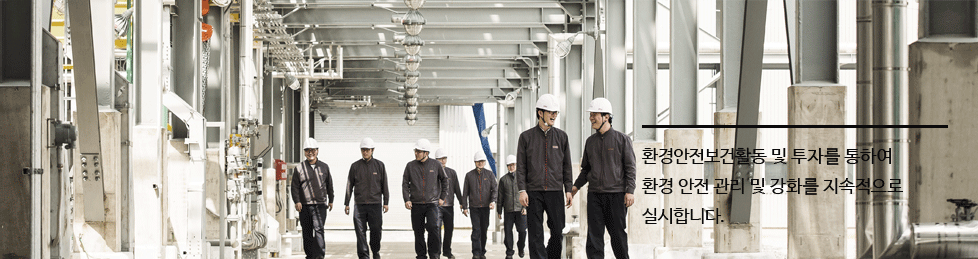
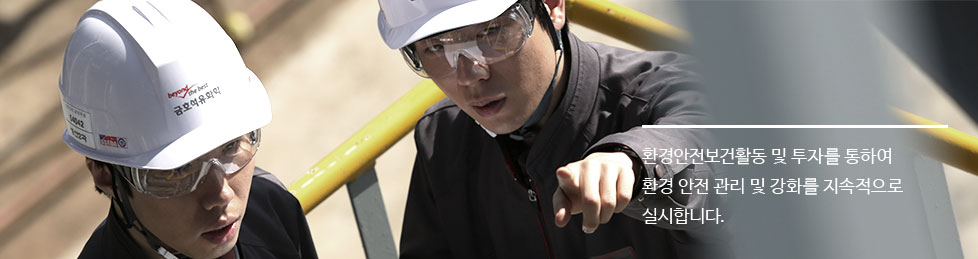
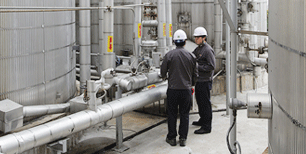
We continuously implement and strengthen environmental and safety management through safety, environment, and health activities and investments.
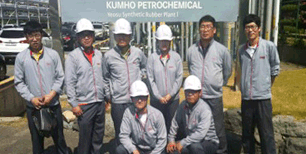
SEH gathering and execution of safety cross examination
and continuously implements benchmarking of excellent cases and strengthening of safety management prevention activities.
Integrated meeting on SEH
exchanges information on environmental safety activity cases and management techniques, and finds and tracks problems
or risk factors in safety, environment and health management, reflecting the active interest and firm will of top management
toward safety, environment and health.
Installation of SEH (Safety, Environment and Health) integrated management system
and to advance the management system, we have changed from the existing ERP (SAP) based system to a web-based system,
contributing to improving work efficiency.
In addition, we expect to improve user convenience through computerized management of safety, environment and health data
and linkage with other systems. The system consists of management, safety, PSM, environment, health, chemical substances,
and Serious Accident Punishment Act menus.
Safety Environment and health management system (internal/external evaluation)
ISO 14001 environmental management system and ISO 45001 safety and health management system.
Through this, we supplement our safety, environment and health management system and build a more advanced system.
Activity Details
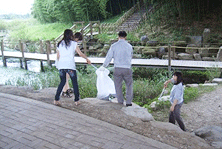
- One company one stream purification
- Period : once a month (Participants – 150/year)
- Location : Mugeocheon Stream, Ssangbongcheon Stream, Samho Island area etc.
-
Details : waste collection, promotion activity towards local residents and tourists
water pollution analysis, removal of weed
- One company one mountain purification
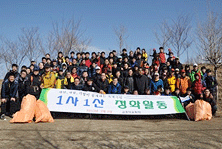
- Period : 4 times/year
- Location : Moonsoo Mountain, Ulsan etc.
- Participants : 90/year
- Details : waste collection, promotion activity towards local residents

- One company one swamp purification activity
- Period : once/quarter
- Location : Hwaeum Swamp, Cheonseong Mountain, Yangsan
- Details : waste collection, ecosystem change observation etc.
- Nature ecosystem conservation
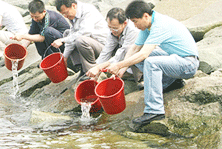
- Period : once/month (Participants – 50/year)
- Location : Heojigi Reservoir, Doodong-meon, Ulju-gun,
Daeeuncheon Stream, Jangsaengpo Maritime Park -
Details : bullfrog and tadpole eradication movement,
feeding migratory birds in the bitter cold, marine ecosystem conservation
activity, fry discharge event, exotic plant eradication movement
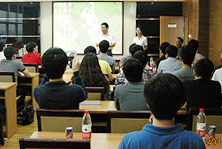
- Environment and Safety Education for Local Residents
-
Purpose : raise local residents' consciousness on environment conservation spirit
- explain government's environment related policies to employees and their family as well as the nearby residents
- promote reducing disposable products, waste separate collection method and status quo of petrochemical industrial complex and Kumho Petrochemical's environment conservation related activities
- deliver tips to prevent accidents related to electricity and gas facilities, provide hands-on experience about using fire extinguisher

The corporate's environmental costs are mainly used for consignment for a wastewater treatment facility, waste treatment, and energy/GHG gas reduction activities. The operational expenses introduced for the purpose of a more systematic environmental management are added, which makes growing environmental costs. For the reduction of environmental burden and the creation of a pleasant environment through facility investment and greening projects for business sites, Kumho Petrochemical is continuously increasing the environmental investments. For instance, the facility investments include the installation of microbial decomposition facilities (bio-filter) for volatile organic compounds (VOCs) and odor treatment, and construction of soil pollution prevention facilities, RTO installation. Kumho Petrochemical constantly strives to reinforce environment and safety competitiveness and execution ability with the safety of its employees and partner companies as the top priority of management subject. We discover risks and hazards in business sites and improve facilities to prevent safety accidents as we focus on reinforcing safety management in all sites through replacing obsolete equipment and making more facility investment.
RC Introduction
RC Code consists of 6 codes, local society recognition and emergency response, process safety, workers' safety and health, environment protection, transportation safety, and the principle of product responsibility. Each code consists of a 'purpose' that describes the main points, 'basic policy and relation' that discloses the chemical industry's publicness outside related to the implementation of Responsible Care, and 'implementation guideline' that is comprised of practice items necessary to fulfill the purpose of the code.
Implementation Guideline (COMPS ; CODE OF MANAGEMENT PRACTICES)
Implementation guideline is a specific RC implementation plan. Kumho Petrochemical figures out the most significant concern outside the company and maps out and fulfills concrete goals and plans in line with the implementation guideline at each site to support performance improvement.
Implementation Guideline Details
Process Safety
- Purpose
- The purpose of the process safety code is to protect workers, property, environment, etc. by preventing fires, explosions, and leakage accidents in chemical plants, and to instill trust in all stakeholders such as government and local residents that chemical plants are safe plants. This code consists of implementation guidelines necessary to achieve this purpose, and the purpose of this code can be achieved by pursuing continuous improvement activities according to each of these implementation guidelines. This code is based on the principle that safety can be guaranteed if all facilities are designed/constructed/operated according to appropriate engineering standards, properly maintained, and periodically checked for suitability. The main contents of the process safety code include related laws and regulations such as the process safety management system applied in Korea, and are written with emphasis on preventive safety management.
- Relationship with Basic Policy
-
This code is a guideline for achieving the items specified in the basic policy, and focuses on implementing the following items.
- We strive to minimize risks that may occur throughout the entire process of product production, transportation, use, and disposal, and prioritize environment, safety, and health.
- We actively communicate and respond to environmental, safety, and health concerns of corporate members, customers, local communities, and related organizations.
- We provide sufficient consultation and appropriate information to customers about the risks of chemical products to guide safe use, transportation and disposal. - Implementation Guidelines
-
1. Management participation In order to continuously improve the factory's management environment and safety through RC, top management must demonstrate leadership by presenting policies, actively participating, sharing information, and providing necessary resources.
2. Goal setting RC clearly defines responsibility for achieving set goals for continuous improvement of process safety.
3. Performance measurement Measure performance according to continuous improvement activities and implement items pointed out in audit results.
4. Accident investigation Identify and eliminate factors that may cause or lead to fires, explosions, or chemical substance leakage accidents, and when accidents occur, take measures to prevent recurrence through thorough investigation and analysis of accident causes, and share related information among member companies.
5. Documentation of process safety information Through history management, periodically update information on design, operation, and maintenance results and procedures for factory equipment and operation variables in real time, and record and maintain past data.
6. Standardization of safety design, manufacturing, installation, and inspection Standardize and comply with various procedures related to standards and inspections for design, manufacturing, and installation of processes and equipment.
7. Material information of hazardous materials Perfectly document material information, hazards, and emergency response information for raw materials, additives, products, by-products, etc., from procurement, handling, storage, to disposal, and promote them to workers, customers, and local residents.
8. Risk assessment Periodically evaluate and document process risks when processes and facilities change, and perform activities to minimize risks related to chemical plant operations, including the possibility of human error.
9. Process/facility change management When changing processes, operations, or facilities, perform change management to maintain or enhance the fundamentally introduced safety.
Workers' Safety and Health
- Purpose
- The purpose of the workers' safety and health code is to promote the safety and health of workers working in the workplace and those entering from partner companies. To achieve this purpose, this code is designed to continuously improve safety and health in the workplace. This code provides various professional methods to promote identification and evaluation of risks, prevention of unsafe behaviors and conditions, maintenance and improvement of worker health, and communication on safety and health issues. This code consists of implementation guidelines necessary to achieve this purpose, and the purpose of this code can be achieved by pursuing continuous improvement activities according to each of these implementation guidelines.
- Relationship with Basic Policy
-
This code is a guideline for achieving the items specified in the basic policy, and focuses on implementing the following items.
- Establish Responsible Care as one of the management goals and have all corporate members participate in the implementation program.
- We strive to minimize risks that may occur throughout the entire process of product production, storage, transportation, use, and disposal, and prioritize environment, safety, and health.
- We actively communicate and respond to environmental, safety, and health concerns of corporate members, customers, local communities, and related organizations.
- We cooperate with government agencies or experts to solve problems and develop technologies related to environment, safety, and health. - Implementation Guidelines
-
1. Safety and health policy and resource securing Safety and health policies for securing the safety of workers and partner companies must be prepared and resources for safety and health must be secured.
2. Worker participation Workers must be given opportunities to participate in developing, implementing, and reviewing safety and health programs.
3. Partner company management When selecting partner companies, it is necessary to check whether programs for the safety and health of partner company workers are appropriate, and programs for sharing safety and health rules of the workplace must be prepared.
4. Safety and health program Legal requirements related to safety and health must be implemented, standards related to worker safety and health must be prepared and implemented, and evaluation of appropriate implementation must be conducted.
5. Work environment management Risks related to worker safety and health that may arise from processes, equipment, chemical agents, work conditions, etc. must be evaluated.
6. Health management Periodic health examinations must be conducted for worker health management, results must be analyzed, and continuous promotion of necessary improvements must be implemented.
7. Safety design and change management A system for performing process design considering safety and health and reviewing changes in equipment and work must be established.
8. Use of safety and health devices A system must be established to check whether safety and health devices and personal protective equipment are properly selected, maintained, and used.
9. Preventive inspection and organization Preventive plans must be established and implemented, and organization must be implemented to maintain the safety of equipment, tools, and equipment.
10. Accident rate analysis Safety and health-related performance must be evaluated, trends must be analyzed, and improvement measures must be identified. For this purpose, a system for data analysis and record keeping must be established.
Environment Protection
- Purpose
- The purpose of the environment protection code is to reduce the amount of all pollutants discharged from facilities to air, water, and soil, and to protect workers and the environment by reducing generated waste, and to enhance awareness of environment, safety, and health among all stakeholders such as local residents. This code consists of implementation guidelines necessary to achieve this purpose, and the purpose of this code can be achieved by pursuing continuous improvement activities according to each implementation guideline. This code is not limited to efforts to reduce emission sources and other pollutants and waste emissions, but also includes a wider range. Each member company must manage pollutants and waste in a way that protects the environment, safety, and health of workers and local residents.
- Relationship with Basic Policy
-
This code is a guideline for achieving the items specified in the basic policy, and focuses on implementing the following items.
- Establish Responsible Care as one of the management goals and have all corporate members participate in the implementation program.
- We strive to minimize risks that may occur throughout the entire process of product production, transportation, use, and disposal, and prioritize environment, safety, and health.
- We actively communicate and respond to environmental, safety, and health concerns of corporate members, customers, local communities, and related organizations.
- We provide sufficient consultation and appropriate information to customers about the risks of chemical products to guide safe use, transportation and disposal.
- We cooperate with government agencies or experts to solve problems and develop technologies related to environment, safety, and health.
- We actively promote information exchange on environment, safety, and health with the international chemical industry and participate in necessary international activities. - Implementation Guidelines
-
1. Company environmental policy There must be a firm determination of top management through policies, communication, and resource support for continuous reduction of pollutants and waste generated from each facility in the workplace to air, water, and soil.
2. Investigation of pollutants and waste Quantitative amounts measured or estimated at each facility's generation/emission points for pollutants discharged to air, water, and soil and generated waste must be investigated.
3. Impact assessment of pollutant and waste emissions Sufficient evaluation must be conducted to establish priority for reducing potential impacts of pollutants and waste discharged on workers' and residents' environment, safety, and health.
4. Education and communication with workers Communicate and educate workers about risks, impact assessments, and inventories to local communities.
5. Pollutant and waste reduction plan Determine priority for reducing pollutant and waste emissions and establish detailed target plans considering environmental impacts.
6. Implementation of pollutant and waste reduction The most desirable measures for continuous reduction of pollutants and waste are ① generation reduction ② recycling/reuse ③ treatment, and these technologies can be used alone or in combination with other technologies depending on the case.
7. Regular performance check of pollutants and waste Check the reduction status of pollutants and waste generated from each facility at least once a year.
8. Communication on pollutant and waste reduction Continuously exchange opinions and listen to workers and local residents about emission data, reduction rates, and future plans of pollutants and waste, and discuss their concerns and measures.
9. Pollutant and waste reduction in change and new construction stages When designing for new construction or process improvement, or when conducting research for product development, methods for reducing pollutant emissions and waste must be included.
Transportation Safety
- Purpose
- The purpose of the transportation safety code is to reduce risks that may harm transportation companies, distribution companies, chemical industry workers, and the general public and environment during the distribution process of chemical substances. By complying with this code, member companies can continuously distribute chemical substances more safely and will evaluate risks related to chemical substance transportation and methods to reduce these risks, and will meet or exceed all rules and industry standards that regulate chemical substance transportation processes. In addition, member companies will provide advice and support for emergency measures to people at the scene in case of emergency situations during chemical substance transportation, and will be able to receive help in developing new technologies to improve chemical substance transportation safety.
- Relationship with Basic Policy
-
This code is a guideline for achieving the items specified in the basic policy, and focuses on implementing the following items.
- Recognize and respond to local community concerns about chemical substance management of member companies.
- Prioritize environment, safety, and health in planning all existing or new products and processes.
- Discuss safe use, transportation, and handling of chemical substances with customers.
- Operate factories and facilities in a way that protects workers and the general public's environment, safety, and health.
- Participate with government and other institutions in the process of creating laws, regulations, and standards to protect local communities, companies, and the environment.
- Promote implementation of RC's basic policy and implementation guidelines by sharing experiences and providing support with other companies that produce, handle, use, transport, and process chemical substances. - Implementation Guidelines
-
1. Risk assessment Periodic evaluation of chemical substance distribution risks considering the possibility of chemical substance leakage in transportation routes, exposure to people and environment, possibility of accidents, or risks of transported substances
2. Implementation of risk reduction measures Implementation of appropriate chemical substance distribution risk reduction measures according to risk level
3. Response to accidents during distribution Internal reporting and investigation of accidents during chemical substance distribution, implementation of accident prevention measures
4. Review of distribution-related legal requirements and industry standards Interpretation and review of laws and industry standards related to chemical substance distribution, and procedures for continuously managing changes
5. Worker education and training Education and training for workers to properly implement transportation-related laws and internal regulations
6. Information provision and suitability review for external company personnel Provide transportation companies, distribution companies, and partner company employees who work on product transportation with behavioral guidelines and information according to company rules, and regularly review their suitability for applicable laws and various company requirements
7. Transportation company qualification granting procedure and management Establish procedures to regularly check and grant qualifications to all forms of transportation companies that transport chemical substances to ensure safety and compliance with laws
8. Selection of transportation containers Establish documented procedures for selecting and using containers suitable for chemical substances to be transported according to test and certification requirements without leakage or external defects
9. Loading and unloading procedures Establish documented procedures for managing facilities that can prevent environmental pollution, protect people, and ensure safety when loading and unloading chemical substances
10. Environment protection Establish appropriate treatment standards for environmental pollution accidents in the chemical substance distribution process such as tank truck, transportation container residue treatment, and leakage accidents during transportation
Product Responsibility
- Purpose
- The purpose of this code is to ensure that safety, health, and environment are preserved throughout the entire process from product development to production, sales, distribution, consumption, recycling, and disposal. This code provides implementation guidelines to continuously improve product safety and presents methods to evaluate achievement. This code applies to the entire process of products. The ultimate performance goal can be said to be responsibility sharing, and all people who handle products must fulfill their responsibilities to stakeholders, such as enabling safe use of products and maintaining a clean environment. Safe workplaces must be provided to employees, and all people who use the company's products must follow appropriate handling methods to ensure that the company's products become safe and environmentally harmless products.
- Relationship with Basic Policy
-
This code is a guideline for achieving the items specified in the basic policy, and focuses on implementing the following items.
- Prioritize environment, safety, and health when expanding or changing existing or new products and processes.
- Develop and produce safe products in production, distribution, and handling.
- Identify the impact of the company's products, manufacturing processes, and waste on environment, safety, and health, and provide more related information.
- Inform customers about information so they can safely use, transport, and dispose of products.
- Inform government agencies, workers, customers, information agencies, and other related stakeholders about the health and environmental hazards related to products and present protection measures.
- Product responsibility policies and requirements must be provided to manufacturers, handlers, users, transporters, and disposal processors of products so they can be complied with. - Implementation Guidelines
-
1. Management will Express top management leadership through documented policies, active participation, communication, etc.
2. Performance measurement Establish goals and responsibilities for implementing product responsibility throughout the organization. Measure performance against these goals.
3. Resource provision Provide resources necessary to support and maintain product responsibility implementation.
4. Product information management Establish and maintain information on environmental, safety, and health risks of existing and new products and reasonably predictable exposure.
5. Product risk assessment and management Classify characteristics considering safety, health, and environmental risks and predictable risk exposure for existing and new products. Establish a system for future re-evaluation. Establish a system to identify, document, and implement safety and health risk management measures appropriate to product risks.
6. Product lifecycle management Establish and maintain a system that considers environmental, safety, and health impacts (including energy and natural resource use) as important factors when designing, developing, and improving products and processes.
7. Product information education Educate and train workers on correct handling, use, recycling, disposal methods, and known product usage methods according to their work.
8. Subcontractor management When selecting subcontractors, select companies that implement appropriate practices for environment, safety, and health protection, or cooperate so that contractors can complete such practices.
Provide appropriate information and guidelines on product and process risks so that appropriate handling, use, recycling, and disposal can be achieved. Periodically review subcontractor performance.
9. Supplier management Ensure that suppliers provide environmental, safety, and health information and guidelines about their products. Consider elements that adhere to thorough environmental, safety, and health principles like RC principles when making purchasing decisions.
Local Society Recognition and Emergency Response
- Purpose
- The purpose of the local society recognition and emergency response code is to ensure emergency response readiness and create local community awareness. This code requires information disclosure promises and dialogue with local communities. This code has two important elements. The first is to start and continuously maintain a local community OUTREACH program that can help local communities understand public concerns and questions about the impact of member companies' factories that manufacture, process, use, distribute, and store hazardous substances on local community environment, safety, and health by transparently disclosing useful information related to this, and the second is to have a rapid and effective emergency response program for each company to protect workers and local residents. The local community OUTREACH element will inform about program activities and performance based on implementation guidelines of all codes and promote open dialogue between workers and local communities. This information should include waste minimization, pollutant emission reduction, human impact of chemical substances, and safe transportation efforts of chemical substances. This code is based on the content of ACC (American Chemistry Council) and supports local community awareness of chemical industry operations and their environmental, safety, and health impacts. The local society recognition and emergency response code basically arose voluntarily triggered by emergency response, and the implementation guidelines of this code expand to company-to-local community dialogue areas in all fields of environment, safety, and health.
- Relationship with Basic Policy
-
This code is a guideline for achieving the items specified in the basic policy, and focuses on implementing the following items.
- Respond to and recognize local community interests related to chemical substances and their operations.
- Immediately provide information about the impact of chemical substances on health and environment to public agencies, workers, customers, and local residents, and present response measures.
- Participate with government and other institutions in creating laws, regulations, and standards to protect local communities, companies, and environment.
- Promote implementation of Responsible Care principles and implementation guidelines by sharing experiences and providing support with people who produce, handle, use, transport, and process chemical substances. - Implementation Guidelines
-
Local Society Recognition and OUTREACH
Member companies with facilities that manufacture, process, use, distribute, and store hazardous substances must have a local community OUTREACH program that includes the following.
Guidelines for workers:
1. Worker awareness assessment Continuously assess workers' concerns and questions about the company.
2. Communication education Provide communication education to dedicated employees who communicate with workers and local residents about environmental, safety, and health issues.
3. Worker education Provide worker education on the company's emergency response plan and safety, health, and environment programs.
4. Dialogue with workers Respond to workers' concerns and questions, and continuously communicate to encourage their participation in local community OUTREACH activities.
5. Periodic evaluation of communication effectiveness with workers Periodically evaluate the effectiveness of continuous communication efforts with workers.
Guidelines for local communities:
6. Local community awareness assessment Continuously assess local community concerns and questions about the company.
7. Local community education Educate stakeholders such as local residents, other companies, media, and government agencies about the company's emergency response program and risks.
8. Dialogue with local communities Respond to local residents' concerns and questions about environment, safety, and health, and continuously communicate with local residents about other concerns.
9. Company openness policy Companies conduct open activities to disclose information in appropriate ways to people interested in company facilities, operations, production products, or environment, safety, and health efforts.
10. Periodic evaluation of communication effectiveness with local communities Periodically evaluate the effectiveness of continuous communication efforts with local communities.
Emergency Response
Member companies with facilities that manufacture, process, use, distribute, and store hazardous substances must have an emergency response program that includes the following.
11. Risk assessment Continuously assess potential risks to workers and local communities from accidents or other emergency situations.
12. Emergency response plan development Document the company's emergency response plan including items necessary for local community recovery after emergency situations and communication processes.
13. Emergency response education Provide continuous education for workers responsible for responding or contacting in emergency situations.
14. Emergency response training Conduct emergency response training at least once a year to verify the performance capability of the emergency response plan.
15. Information exchange with emergency response related agencies Exchange appropriate and practical emergency response plan information with local emergency response related agencies.
16. Emergency response related personnel company tour Improve emergency response readiness and provide latest information on factory operations by touring emergency response related personnel to factories.
17. Emergency response cooperation system establishment Establish a comprehensive cooperation system with local and other factory emergency response plans. If such response plans do not exist, the company should work to establish plans.
18. Participation in local emergency response plan development Participate in local emergency response plan development to periodically review and develop comprehensive local emergency response plans created by local emergency response related agencies.
19. Information sharing with other companies Share information and experiences related to emergency response plans, training, and accident handling with other companies in the area.
RC Policy
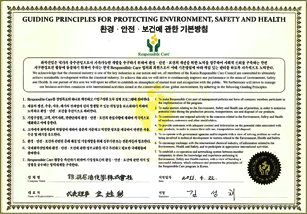
Implementation of Responsible Care is a token of the CEO to actively support
responsible management of chemical substances, an expression of the chemical
industry's willingness to proactively consider the public's concern related
to the negative impact chemical substances and hazardous waste can have on
the environment, safety and healthcare industry.